This blog is about historical and cultural sites, places and events all over the world visited by bicycle or that could be visited by bicycle. It is to show that a motor vehicle does not always have to be used and it is often better to visit these places by bicycle.
Showing posts with label buildings. Show all posts
Sunday, September 17, 2017
Spencer, Iowa: 2017 Clay County Fair, Museum, Buildings and Booths, 09/15/2017
Previous articles in the series:
Spencer, Iowa: 2017 Clay County Fair, Museum, Introduction and Timeline, 09/15/2017
Spencer, Iowa: 2017 Clay County Fair, Museum, 1917 Hudson Super 6, 09/15/2017
Spencer, Iowa: 2017 Clay County Fair, Museum, Shirts, Sweatshirts and Quilts, 09/15/2017
Spencer, Iowa: 2017 Clay County Fair, Museum, 1928 International six-speed special, 09/15/2017
Spencer, Iowa: 2017 Clay County Fair, Museum, Awards and Ribbons, 09/15/2017
Spencer, Iowa: 2017 Clay County Fair, Museum, Warren Brothers Band, 09/15/2017
Spencer, Iowa: 2017 Clay County Fair, Museum, Iowa Corn and Small Grain Trophy, 09/15/2017
Spencer, Iowa: 2017 Clay County Fair, Museum, 1930 Ford Model A Coupe, 09/15/2017
Spencer, Iowa: 2017 Clay County Fair, Museum, Fair Managers, 09/15/2017
Spencer, Iowa: 2017 Clay County Fair, Museum, Spotlights, 09/15/2017
Spencer, Iowa: 2017 Clay County Fair, Museum, 1941 Ford Super Deluxe Convertible Coupe, 09/15/2017
Spencer, Iowa: 2017 Clay County Fair, Museum, Chuck Wagon Racing, 09/15/2017
Spencer, Iowa: 2017 Clay County Fair, Museum, Nick Milleman, 09/15/2017
Spencer, Iowa: 2017 Clay County Fair, Museum, 1957 Chevrolet Bel Air Convertible, 09/15/2017
Spencer, Iowa: 2017 Clay County Fair, Museum, Fair Banner's and Sign's, 09/15/2017
Spencer, Iowa: 2017 Clay County Fair, Museum, Auto Racing, 09/15/2017
Spencer, Iowa: 2017 Clay County Fair, Museum, Ben Sanders Chair and Shirt, 09/15/2017
Spencer, Iowa: 2017 Clay County Fair, Museum, 1965 Ford Mustang 2+2 Fastback, 09/15/2017
Spencer, Iowa: 2017 Clay County Fair, Museum, Miss Clay County Fair, 09/15/2017
Spencer, Iowa: 2017 Clay County Fair, Museum, Beef Market Champion Trophy, 09/15/2017
Spencer, Iowa: 2017 Clay County Fair, Museum, 1986 Ford Bronco II, 09/15/2017
Spencer, Iowa: 2017 Clay County Fair, Museum, Check, 09/15/2017
Spencer, Iowa: 2017 Clay County Fair, Museum, Fruit, Vegetable and Flower Displays, 09/15/2017
Tuesday, August 20, 2013
Historic South Dakota: Sioux Falls, United States Courthouse
Timeline:
November 2, 1889 - South Dakota became a state.
December 29, 1890 - The U.S. Army 7th Calvary Regiment entered a Lakota Camp at Wounded Knee to disarm the residents when a fight occurred. A Shot was fired and the Army soldiers panicked and began shooting indiscriminately at the Native Americans. When it was over 150 men, women and children of the Lakota tribe had been killed. 25 Army soldiers were also killed by friendly fire.
After the incident it was decided a federal building in Sioux Falls was needed to create a sense of stability for the young state. and act as a beacon of permanence and sophistication for the current and new settlers.
July 22, 1891 - The U.S. Government purchased a two lot parcel on the corner of 12th Street and Philips Avenue dedicated to the construction of a Federal building in Sioux Falls, South Dakota. The bill to fund the structure was introduced by South Dakota's first Senator, Richard Pettigrew.
Supervising Architect of the Treasury, W.J. Edbrooke designed the building to house a post office on the first floor and a courthouse on the second floor with the main entrance on Phillips Avenue. Part of the original design was a basement for storage. The style of the exterior is Richardsonian Romanesque with wide arches, rusticated stone accented with smooth stone finishes and monumental massing.
1892 to 1895 - The construction of the new Federal building took place at a cost of $152,000.
1895 - President Benjamin Harrison appoints Judge Alonzo J. Edgerton as the first judge to occupy the courthouse.
1911 to 1913 - Under supervising Architect of the Treasury, James Knox Taylor the building was extended 30 feet to the east and the third floor was added.
Substantial interior alterations were also completed. The post office lobby was extended, the turret stair was replaced with a new marble stair was placed in the southwest portion of the original building and an elevator was installed in the adjacent lobby. The new public hallways, lobbies and stairs featured marble baseboards, treads, landings and terrazzo with a marble border served as flooring.
1931 to 1933 - Under the direction of Supervising Architect of the Treasury James A. Wetmore a two story wing with full basement was added to the east side of the building. Like the 1911 alterations, the new addition was sympathetic to the original building.
1941 - A new elevator is installed.
1956 - A new freight elevator is installed.
1967 - Original slate roof is replaced with green asphalt shingles.
1968 - The post office was relocated to another building. But many features remained the same, including the 1911 iron and marble stairs, the oak paneled courtroom and two small vaults with mural scenes painted on the the doors. The first floor is "modernized".
1972 - New slate roof is installed over asphalt shingles. Second floor southwest judge's suite is remodeled.
1974 - The building was listed on the National Register of Historic Places.
1981 - Third floor mechanical upgraded and remodeled.
1982 to 1983 - Historic courtroom and surrounding spaces remodeled.
1985 - Historic courtroom restored.
1993 - All brass piping replaced with copper.
1995 - The buildings centennial celebration occurs. Pre-1995 new courtroom on the first floor constructed.
2000 - New courtroom on the second floor constructed.
Present Day - The building houses federal offices and courts.
U.S. Courthouse, Sioux Falls, South Dakota
November 2, 1889 - South Dakota became a state.
December 29, 1890 - The U.S. Army 7th Calvary Regiment entered a Lakota Camp at Wounded Knee to disarm the residents when a fight occurred. A Shot was fired and the Army soldiers panicked and began shooting indiscriminately at the Native Americans. When it was over 150 men, women and children of the Lakota tribe had been killed. 25 Army soldiers were also killed by friendly fire.
After the incident it was decided a federal building in Sioux Falls was needed to create a sense of stability for the young state. and act as a beacon of permanence and sophistication for the current and new settlers.
July 22, 1891 - The U.S. Government purchased a two lot parcel on the corner of 12th Street and Philips Avenue dedicated to the construction of a Federal building in Sioux Falls, South Dakota. The bill to fund the structure was introduced by South Dakota's first Senator, Richard Pettigrew.
Supervising Architect of the Treasury, W.J. Edbrooke designed the building to house a post office on the first floor and a courthouse on the second floor with the main entrance on Phillips Avenue. Part of the original design was a basement for storage. The style of the exterior is Richardsonian Romanesque with wide arches, rusticated stone accented with smooth stone finishes and monumental massing.
1892 to 1895 - The construction of the new Federal building took place at a cost of $152,000.
1895 - President Benjamin Harrison appoints Judge Alonzo J. Edgerton as the first judge to occupy the courthouse.
1911 to 1913 - Under supervising Architect of the Treasury, James Knox Taylor the building was extended 30 feet to the east and the third floor was added.
Substantial interior alterations were also completed. The post office lobby was extended, the turret stair was replaced with a new marble stair was placed in the southwest portion of the original building and an elevator was installed in the adjacent lobby. The new public hallways, lobbies and stairs featured marble baseboards, treads, landings and terrazzo with a marble border served as flooring.
1931 to 1933 - Under the direction of Supervising Architect of the Treasury James A. Wetmore a two story wing with full basement was added to the east side of the building. Like the 1911 alterations, the new addition was sympathetic to the original building.
1941 - A new elevator is installed.
1956 - A new freight elevator is installed.
1967 - Original slate roof is replaced with green asphalt shingles.
1968 - The post office was relocated to another building. But many features remained the same, including the 1911 iron and marble stairs, the oak paneled courtroom and two small vaults with mural scenes painted on the the doors. The first floor is "modernized".
1972 - New slate roof is installed over asphalt shingles. Second floor southwest judge's suite is remodeled.
1974 - The building was listed on the National Register of Historic Places.
1981 - Third floor mechanical upgraded and remodeled.
1982 to 1983 - Historic courtroom and surrounding spaces remodeled.
1985 - Historic courtroom restored.
1993 - All brass piping replaced with copper.
1995 - The buildings centennial celebration occurs. Pre-1995 new courtroom on the first floor constructed.
2000 - New courtroom on the second floor constructed.
Present Day - The building houses federal offices and courts.
U.S. Courthouse, Sioux Falls, South Dakota
Labels:
America,
bicycle,
buildings,
cities,
constructed,
culture,
eagle,
Federal Courthouse,
historic markers,
Historic South Dakota,
historical sites,
history,
new,
old,
pieces,
rich,
several,
Sioux Falls,
South Dakota
Sunday, August 18, 2013
Historic South Dakota: Sioux Falls, Historic Sculpture
Through out the history of Sioux Falls, South Dakota several of its buildings have been torn down and new buildings constructed in their place. Pieces from some of the old, former buildings survived the demolition and were salvaged to be used on the newer building and/or put on public display such as this eagle:
Labels:
America,
bicycle,
buildings,
cities,
constructed,
culture,
eagle,
historic markers,
Historic South Dakota,
historical sites,
history,
new,
old,
pieces,
rich,
several,
Sioux Falls,
South Dakota,
within
Monday, May 27, 2013
RAGBRAI XXXVIII
RAGBRAI or the Register's Annual Great Bicycle Ride Across Iowa as the worlds oldest, largest, longest and best multi-day bicycle tour. It always occurs the last full 7 days of July. It starts on or near the western border of Iowa and ends on the eastern border. There are bicycle tours that are older, but not as long in terms of how many days. There are tours that are longer but not as old. As far as being the best, that is a matter of personal opinion. RAGBRAI is the "grand father" of the multi day bicycle tours. The title or description comes from the RAGBRAI officials.
RAGBRAI is also one of Iowa's greatest cultural events. It is one of the most diversified annual events in the state. People from all 50 states and at least 6 countries have participated in RAGBRAI during its 38 year history. The ride attracts over 15,000 people. This year was no exception.
RAGBRAI is always the last full 7 days of July. This year the ride was July 25 to the 31st, starting in Sioux City and ending in Dubuque, Iowa. The RAGBRAI festivities always kick off in the start town on the Saturday before the actual ride starts. There is the RAGBRAI Expo and usually concerts food vendors and a lot of fun.
RAGBRAI web site.
Saturday July 24, 2010. The RAGBRAI welcome, kick off, concerts and Expo in Sioux City, Iowa:


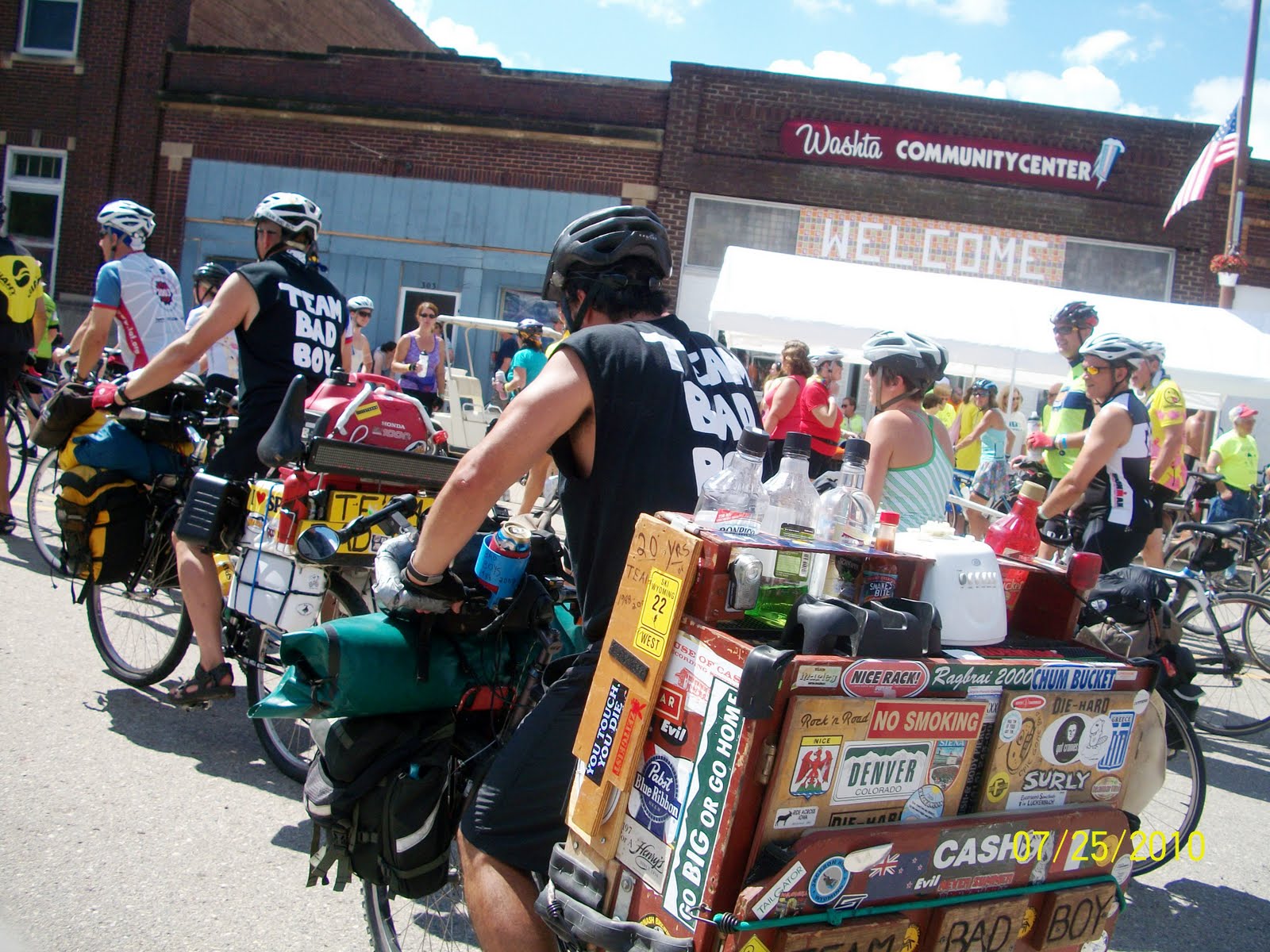
Day 1 Sunday July 25, 2010. Sioux City to Storm Lake. RAGBRAI has many pass through towns, these are 2 from the first day of the ride, Kingsley and Washta. The photos taken in Washta are of Team Bad Boy. Yes that is a full size working grill on the back of the bike. Team Bad Boy have been doing RAGBRAI for at least 20 years and are always fun to talk to and see on the ride.
Kingsley:


Team Bad Boy in Washta:


Day 2 Monday July 26, 2010. Storm Lake to Algona. RAGBRAI sometimes has traffic jams of cyclists. This year a big one occured at the pass through town of Varina, Iowa. Another interesting pass through town was Pochontas, Iowa. There is also a historic marker about a church that was moved and a town that no longer exists. The highlight of this years RAGBRAI was The Grotto of the Redemption.
Traffic jam:


Pocahontas, Iowa:


Historic Marker:

Grotto of the Redemption:


Day 3 Tuesday July 27, 2010. Algona to Clear Lake. In the pass through town of Wesley there was a beautifully painted semi tractor called Blue Angel. It is a 1981 Peterbilt that has won awards in truck shows and appeared in a truck magazine and has over a million miles. In another pass through town there are some interesting old buildings. The name of the town escapes this blog authors memory but the name of the buildings are part of the facade.
Blue Angel:


Buildings:


Day 4 Wednesday July 28, 2010. Clear Lake to Charles City. A resident in one of the pass through towns built some interesting pieces of machinery. This day was also the half way point where RAGBRAI crossed Interstate 35.
Machinery:


Half way point:


Day 5 Thursday July 29, 2010. Charles City to Waterloo. In the pass through town of Clarksville had the first yellow fire truck in Iowa and one other antique fire truck on display. The pass through town of Parkersburg had some interesting sculptures on display plus a couple of other interesting things to look at. Hudon, the last pass through town of this day, had a large fake bull used as a sign.
Clarksville:


Parkersburg:


Hudson:

Day 6 Friday July 30, 2010. Waterloo to Manchester. The over night town of Manchester, Iowa, the over night town on 07/31/2010, has a lot to offer in the way of historic sites. The blog author was only able to visit a few of them. The town also had some interesting sculptures as part of their RAGBRAI theme. For historical buildings there is the Deleware County Courthouse, the Masonic Temple and a few other buildings in the downtown area. There was also a race truck on display at an intersection. There will be a more detailed blog post about the Deleware County Courthouse.
RAGBRAI has many teams that participate. One of these teams is Team Stop A Lot. When they pulled into Manchester they stopped, cranked up their cooler stereo and did a line dance in the middle of a downtown street. The crowd loved it.
Delaware County Courthouse:


Masonic Temple:


1876 Building:


Hoac Union Block:


Interesting Architecture:

Race Truck:

Bicycle Sculptures:


Team Stop A Lot:


Saturday July 31, 2010. Manchester to Dubuque. The last day of this years RAGBRAI offered beautiful scenery, architecture and the tire dip at the Mississippi River at the Port of Dubuque. RAGBRAI has food vendors along the route, typically at farm houses and in the pass through towns.
Breakfast stop:


In the pass through town of Dyersville is the beautiful St. Francis Xavier Catholic Basilica. There will be a detailed blog post about the basilica:




Some of the beautiful scenery included the hills and valleys around an area called Potter Hill:


The Port of Dubuque is a scenic area with the view of the Mississippi river and the bridge crossing into Illinois and Wisconsin:


RAGBRAI is also one of Iowa's greatest cultural events. It is one of the most diversified annual events in the state. People from all 50 states and at least 6 countries have participated in RAGBRAI during its 38 year history. The ride attracts over 15,000 people. This year was no exception.
RAGBRAI is always the last full 7 days of July. This year the ride was July 25 to the 31st, starting in Sioux City and ending in Dubuque, Iowa. The RAGBRAI festivities always kick off in the start town on the Saturday before the actual ride starts. There is the RAGBRAI Expo and usually concerts food vendors and a lot of fun.
RAGBRAI web site.
Saturday July 24, 2010. The RAGBRAI welcome, kick off, concerts and Expo in Sioux City, Iowa:


Day 1 Sunday July 25, 2010. Sioux City to Storm Lake. RAGBRAI has many pass through towns, these are 2 from the first day of the ride, Kingsley and Washta. The photos taken in Washta are of Team Bad Boy. Yes that is a full size working grill on the back of the bike. Team Bad Boy have been doing RAGBRAI for at least 20 years and are always fun to talk to and see on the ride.
Kingsley:
Team Bad Boy in Washta:


Day 2 Monday July 26, 2010. Storm Lake to Algona. RAGBRAI sometimes has traffic jams of cyclists. This year a big one occured at the pass through town of Varina, Iowa. Another interesting pass through town was Pochontas, Iowa. There is also a historic marker about a church that was moved and a town that no longer exists. The highlight of this years RAGBRAI was The Grotto of the Redemption.
Traffic jam:


Pocahontas, Iowa:


Historic Marker:

Grotto of the Redemption:


Day 3 Tuesday July 27, 2010. Algona to Clear Lake. In the pass through town of Wesley there was a beautifully painted semi tractor called Blue Angel. It is a 1981 Peterbilt that has won awards in truck shows and appeared in a truck magazine and has over a million miles. In another pass through town there are some interesting old buildings. The name of the town escapes this blog authors memory but the name of the buildings are part of the facade.
Blue Angel:


Buildings:


Day 4 Wednesday July 28, 2010. Clear Lake to Charles City. A resident in one of the pass through towns built some interesting pieces of machinery. This day was also the half way point where RAGBRAI crossed Interstate 35.
Machinery:


Half way point:


Day 5 Thursday July 29, 2010. Charles City to Waterloo. In the pass through town of Clarksville had the first yellow fire truck in Iowa and one other antique fire truck on display. The pass through town of Parkersburg had some interesting sculptures on display plus a couple of other interesting things to look at. Hudon, the last pass through town of this day, had a large fake bull used as a sign.
Clarksville:


Parkersburg:


Hudson:

Day 6 Friday July 30, 2010. Waterloo to Manchester. The over night town of Manchester, Iowa, the over night town on 07/31/2010, has a lot to offer in the way of historic sites. The blog author was only able to visit a few of them. The town also had some interesting sculptures as part of their RAGBRAI theme. For historical buildings there is the Deleware County Courthouse, the Masonic Temple and a few other buildings in the downtown area. There was also a race truck on display at an intersection. There will be a more detailed blog post about the Deleware County Courthouse.
RAGBRAI has many teams that participate. One of these teams is Team Stop A Lot. When they pulled into Manchester they stopped, cranked up their cooler stereo and did a line dance in the middle of a downtown street. The crowd loved it.
Delaware County Courthouse:


Masonic Temple:


1876 Building:


Hoac Union Block:


Interesting Architecture:
Race Truck:

Bicycle Sculptures:


Team Stop A Lot:


Saturday July 31, 2010. Manchester to Dubuque. The last day of this years RAGBRAI offered beautiful scenery, architecture and the tire dip at the Mississippi River at the Port of Dubuque. RAGBRAI has food vendors along the route, typically at farm houses and in the pass through towns.
Breakfast stop:


In the pass through town of Dyersville is the beautiful St. Francis Xavier Catholic Basilica. There will be a detailed blog post about the basilica:


Some of the beautiful scenery included the hills and valleys around an area called Potter Hill:


The Port of Dubuque is a scenic area with the view of the Mississippi river and the bridge crossing into Illinois and Wisconsin:


Subscribe to:
Posts (Atom)